
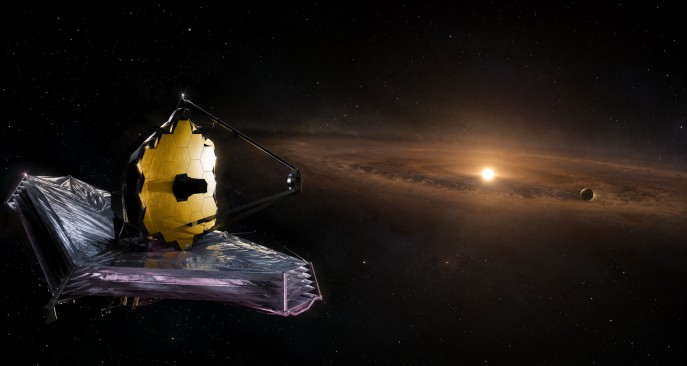
Astronomers have made a groundbreaking discovery using NASA’s James Webb Space Telescope, identifying a new giant exoplanet named Beta Pictoris d. This third known planet in the Beta Pictoris system was found orbiting the star Beta Pictoris, unveiling a previously hidden member of this well-explored planetary system.
Unlike its predecessors, Beta Pictoris d was not discovered through direct imaging. Instead, its presence was revealed by the distinct chemical signature of its atmosphere. The discovery occurred as scientists utilized Webb’s Near-Infrared Spectrograph (NIRSpec) to observe another planet within the same system, leading to this unexpected breakthrough.
The confirmation of Beta Pictoris d came through meticulous analysis of its atmospheric composition and motion, identifying the presence of carbon monoxide, water vapor, and methane. These observations highlighted the planet as a giant residing within the system’s luminous debris disk, a factor that had previously concealed it from traditional imaging methods.
Located roughly 63 light-years from Earth, the Beta Pictoris system, at 23 million years old, serves as a vital framework for understanding planetary formation and evolution. Scientists estimate that Beta Pictoris d possesses a mass at least twice that of Jupiter and orbits its star at a distance similar to Neptune’s in our solar system.
This landmark discovery marks the first occasion an exoplanet has been predominantly identified through moderate-resolution spectroscopy. It represents a promising new technique for uncovering planets obscured by dusty environments and could significantly enhance the search for exoplanets throughout the Milky Way in future explorations.