
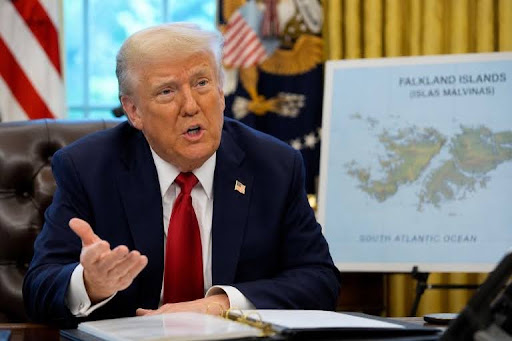
In a development that could alter long-standing international relations, Donald Trump has suggested a potential reassessment of the United States’ stance on the Falkland Islands, raising the possibility of tensions with the United Kingdom. When questioned by reporters about Washington’s position on the sovereignty of this South Atlantic territory, Trump stated that he routinely evaluates all policies, implying that the Falklands could be among those under review. Traditionally, the U.S. has maintained a neutral stance in the sovereignty dispute between Britain and Argentina, although it has generally acknowledged British governance over the islands, which have been under British control since 1833 with the exception of a brief Argentinian occupation in 1982.
Trump’s remarks are being interpreted as a strong indication that his administration may use the Falklands issue as a strategic tool to urge Britain’s new Prime Minister, Andy Burnham, to commit to higher defense spending and NATO participation. A spokesperson for Burnham reiterated Britain’s unwavering stance, emphasizing the islanders’ desire to remain a British overseas territory and affirming London’s dedication to its international defense obligations. This statement comes in the wake of a report from an unnamed U.S. official suggesting that Washington’s position could shift if Britain does not meet its defense spending goals, amid concerns that the UK might lower its target to increase defense spending to 3% of GDP by 2030, ahead of a forthcoming budget announcement.
Throughout Trump’s presidencies, advocating for increased defense spending among allies has been a consistent foreign policy objective. Allies have previously agreed to raise defense and security expenditures to 5% of GDP by 2035. Speculation about a potential U.S. policy change on the Falklands has been rife for months, following a leaked Pentagon communication that suggested revisiting Britain’s claim due to disagreements over the Iran situation. Any modification in the U.S. position would be symbolically significant, given the historical context where U.S. diplomatic support was crucial for Britain during the 1982 Falklands War, which resulted in numerous casualties and reinforced the political bond between the two nations.
Recently, Trump has cultivated a close relationship with Argentina’s president, who supports Argentina’s claim to the islands. This relationship has seen Trump authorize substantial financial aid to Argentina, tied to political conditions, and subsequently ease trade restrictions on Argentinian beef imports. A 2013 referendum demonstrated overwhelming support from Falkland residents for remaining under British rule. The issue has resurfaced in tensions following a provocative gesture by Argentinian athletes after a sporting event, which led to disciplinary action from football’s governing body.