
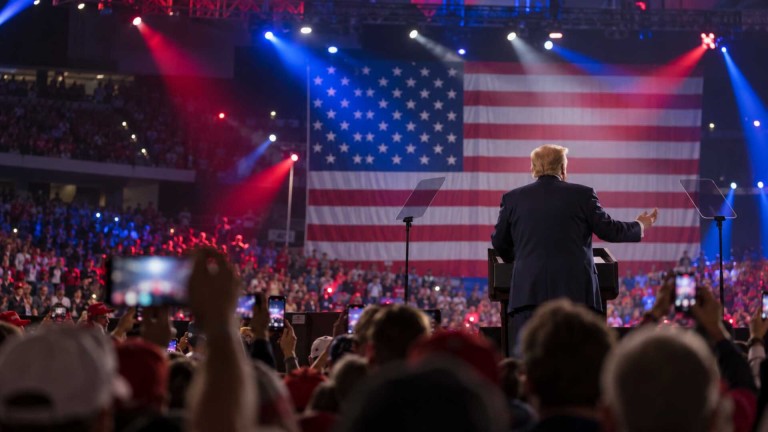
President Donald Trump has decided to reinstate his campaign rallies in Kansas and Iowa, reversing an earlier move to replace them with virtual events. This decision comes as the midterm elections approach in November, a critical test for Republicans who aim to maintain control of Congress.
The Republican National Committee had initially announced that Trump would forego the Kansas and Iowa rallies in favor of participating in numerous tele-rallies targeting voters nationwide. However, the plans were changed on Friday, with the Kansas and Iowa rallies restored, alongside 19 virtual appearances.
The midterm elections are shaping up to be a significant assessment of Trump’s popularity, with Republicans facing intense races that could determine control of both the House of Representatives and the Senate. Democrats are seeking to leverage voter dissatisfaction to reclaim congressional seats.
In Kansas, Republican Senator Roger Marshall is up against a strong challenge from Democratic candidate Adam Hamilton. Kansas has a history of supporting Republican candidates in federal elections, making this race particularly noteworthy.
Iowa is also proving to be a battleground, with competitive contests for both the Senate and the governor’s office. Democrats view these races as opportunities to make gains, driven by voter concerns over rising living costs and federal government performance.
Economic concerns, particularly the increasing cost of living, have become central issues in the election campaign. Additionally, opposition to the administration’s policies, including its approach to the conflict with Iran, has fueled political debate.
Trump’s virtual rallies are set to cover 19 states, including key battlegrounds such as Alaska, Michigan, Nebraska, Ohio, Texas, and South Carolina, where Senate races could impact the balance of power in Congress. The campaign is also focusing on states with competitive House and gubernatorial contests, including Arizona, Colorado, Florida, Nevada, Pennsylvania, and Virginia. With several races expected to be closely contested, the final days of campaigning may prove crucial in determining whether Republicans can retain control of Congress or if Democrats will make significant gains.